.png)
We build the world's smallest, most efficient power converters. Ferric’s Integrated Voltage Regulators power the future of computing and all digital electronics.
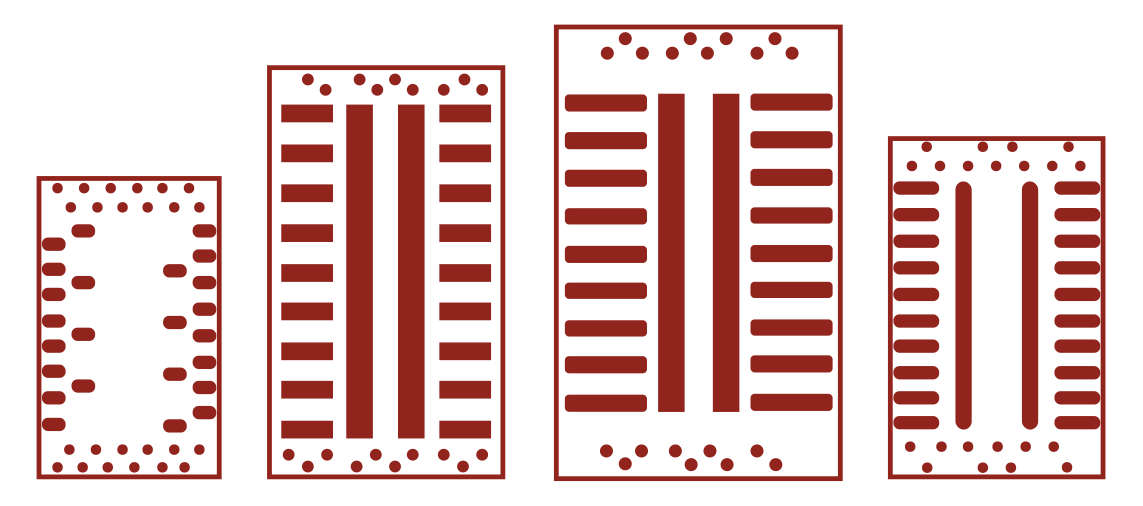
An Integrated Voltage Regulator (IVR) is an advanced power-management technology that moves the final stage of voltage conversion directly inside a processor's package or silicon die, placing it millimeters away from the active circuits
Proximity to Load: Traditional motherboard voltage regulators (VRMs) send high currents over relatively long paths. IVRs sit right next to—or even underneath—the processor core or system-on-chip (SoC), drastically shortening the electrical path.
High Switching Frequencies: IVRs operate at frequencies 10 to 100 times higher (typically 10–100 MHz) than conventional regulators.
Miniaturized Components: High switching speeds allow the use of tiny internal magnetic and passive components, eliminating dozens of bulky external parts from the printed circuit board (PCB).
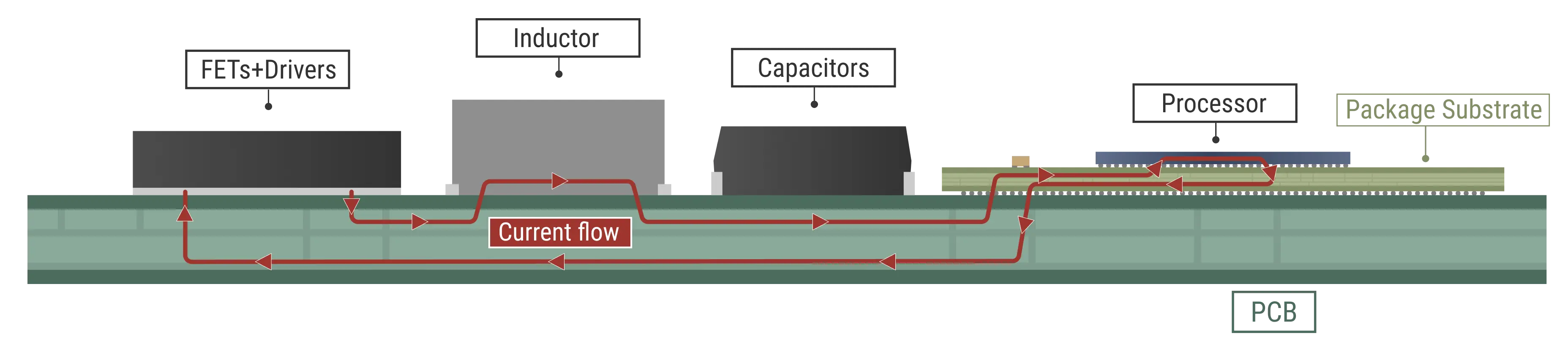
[Conventional Power Delivery Network (PDN)]

.svg)
[Ferric Power Delivery Network (PDN)]
Increasing XPU power consumption creates a space crisis for power delivery.
Traditional solutions (discrete components, large modules) are too bulky.
IVRs (Integrated Voltage Regulators) offer a slim profile but face PDN routing challenges on single-sided packages.
Higher Efficiency: Reduces resistive power losses and wasted energy between the power source and the processor.
Faster Transient Response: Dramatically cuts parasitic inductance and power distribution network (PDN) impedance, enabling near-instantaneous voltage adjustments during heavy workload changes.
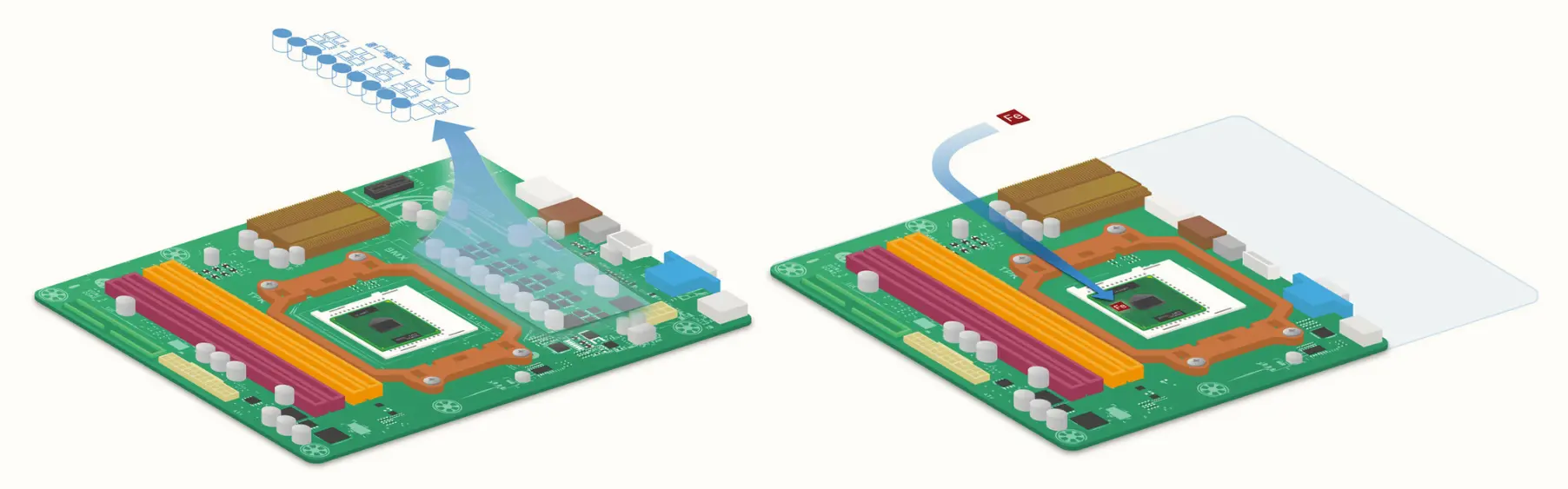
Space Savings: Shrinks the overall footprint by up to 90%, freeing up valuable space on the motherboard for other components.
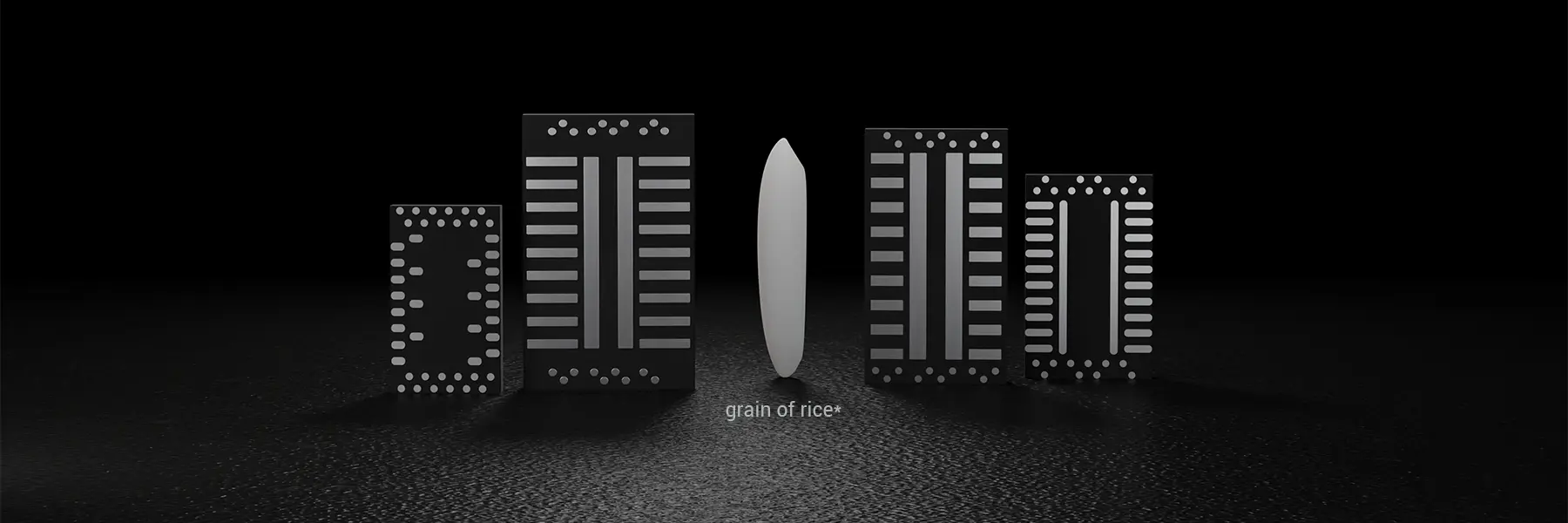
Ferric Power Converters are small enough to co-package with processors. Integration Saves:20-50% Power, 50-70% Board and 20% Cost.
Integrated Voltage Regulators can be deployed close to the processor, within the package, or on the land side of advanced compute systems to shorten the power delivery path and support high-current, high-density loads.
AI Accelerators & GPUs: IVRs can deliver power close to high-current compute dies, helping support fast-changing workloads, dense packaging and increasingly demanding processor power requirements.
High-Performance Computing: In HPC systems, IVRs help reduce the distance between voltage conversion and the load, supporting efficient power delivery in space-constrained, high-power platforms.
Data Centers & Cloud Infrastructure: IVRs can improve power density and point-of-load efficiency in servers and accelerator platforms where energy efficiency, thermal performance and board space are critical.
Custom ASICs & Advanced SoCs: Application-specific processors can use IVRs to create localized power rails closer to individual compute blocks, improving power delivery flexibility and integration.
Networking & Communications: High-performance networking silicon, switches and communications processors can benefit from compact, high-current voltage regulation close to the load.
Advanced Packaging & Chiplet Systems: IVRs can be integrated alongside or beneath processor packages to support multi-die architectures, chiplets and increasingly dense heterogeneous systems.
Ferric stands out because of its unique technical approach to solving the IVR puzzle:
Proprietary Thin-Film Magnetics: One of the hardest obstacles to putting a voltage regulator directly on or inside a processor package is the inductor. Inductors are typically bulky discrete components. Ferric bypassed this by developing CMOS-integrated ferromagnetic thin-film inductors that are built directly onto the silicon. This allows them to shrink the power supply down to a minuscule 35.5 mm² chiplet.
High Current Density for AI: Ferric's flagship product, the Ferric Fe1766, delivers an incredible 160 A at a density of 4.5A/mm². Multiple chiplets can be "ganged" together, meaning they can scale up to deliver over 10 kW of power to massive, power-hungry AI accelerators and GPUs.
Back-End-of-Line (BEOL) Integration: While some competitors build standalone power modules that sit next to the chip, Ferric focuses on Back-End-of-Line (BEOL) fabrication, integrating their thin-film magnetics directly into the chip manufacturing pipeline with foundries like TSMC.
Heavy Commercial Partnerships: Ferric is far from a theoretical startup; they are deeply integrated into the next-generation AI ecosystem. For instance, Marvell Technology partners with Ferric to embed these pre-validated integrated power solutions directly into custom AI and cloud infrastructure platforms.




Talk with Ferric about IVR integration, processor power requirements, technical specifications, samples, and high-density power delivery architectures.
Contact Ferric →
.png)
We build the world's smallest, most efficient power converters. They power the future of computing and all digital electronics.